What does “album amicorum” mean?
Album amicorum is Latin for “album of friends”. Amicorum means “of friends”; it comes from amicus, a friend. The name is usually translated as “book of friends” or “friendship book”, and the historians Sophie Reinders and Jeroen Vandommele suggest “a list of friends” as the closest rendering. The plural is alba amicorum.
The same book went by other names. In Latin it was also called a liber amicorum, a “book of friends”, or a thesaurus amicorum, a “treasury of friends”. In German it was, and still is, a Stammbuch.
Where did the album amicorum begin?
It began at the University of Wittenberg, in all likelihood in the 1540s. Students there asked the reformers Martin Luther and Philip Melanchthon for an autograph to keep, and the great men wrote it into a book the student already owned, such as a Bible. Soon students were asking their other teachers, and then one another.
By the second half of the 1550s the custom had spread through most of the Holy Roman Empire, and from the late 1550s students carried it home to the Low Countries. It took hold across northern and central Europe: the German lands, the Netherlands, Hungary, and Scandinavia. Students took their albums with them to France and Italy, but the custom never settled there.
It grew quickly. The Repertorium Alborum Amicorum, the largest catalogue of these books, records 572 albums from before 1573 and 2,293 by 1600, according to Reinders and Vandommele’s account, which this history follows for the early years.
Who kept an album amicorum?
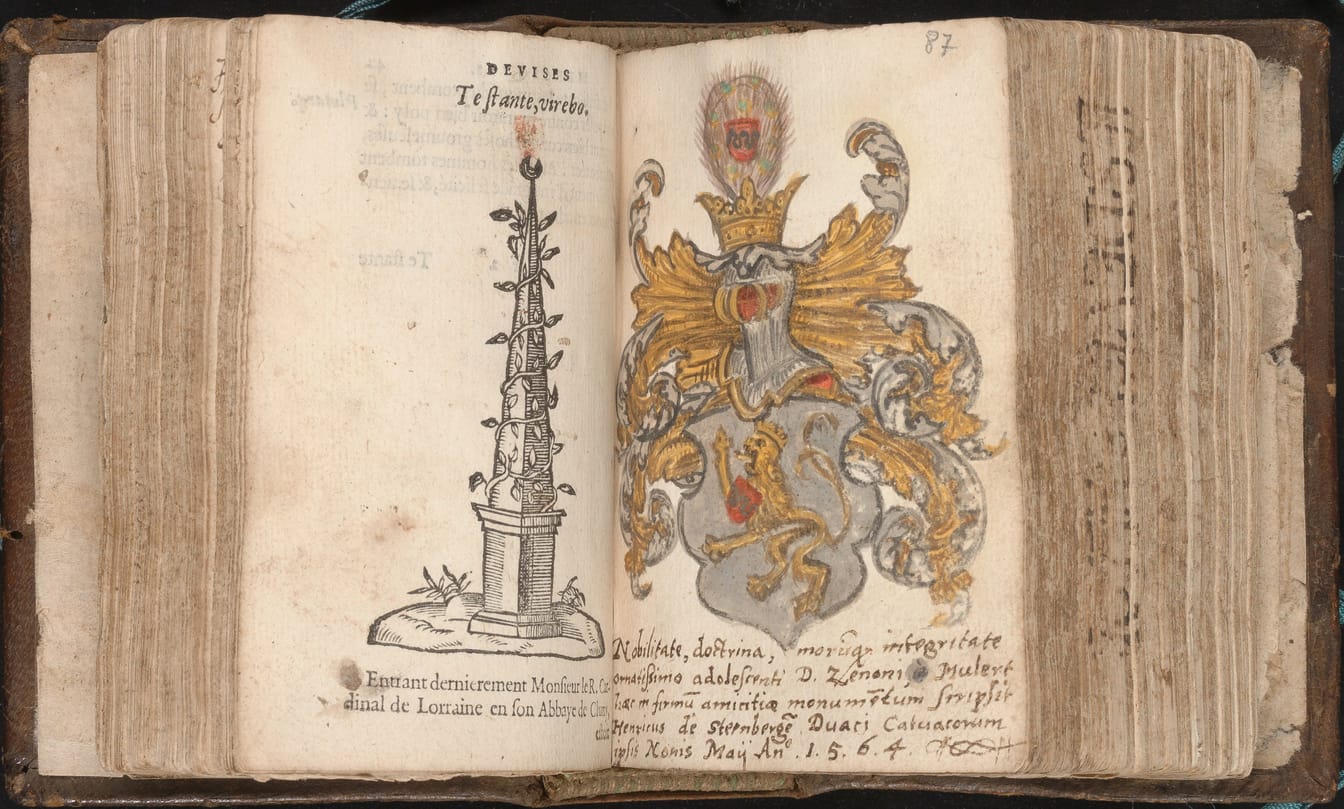
Mostly students, between about eighteen and twenty-four years old. An education then often meant travelling from one university to the next, and the album went along. It recorded the people of those years: professors, tutors, fellow students, people met on the road, relatives, and friends. Many albums were put away when the studies ended. Some owners went on adding to theirs for life, and the album became a common possession of scholars, lawmakers, and other educated professionals.
Others took it up. Artists, merchants, and scholars in Antwerp kept albums in the circle of the mapmaker Abraham Ortelius. Philipp Hainhofer, an art dealer in Augsburg, filled his with the entries of emperors and kings.
Women kept them too, though far fewer survive: a few dozen, against thousands kept by men. Most belonged to noblewomen in the Low Countries, and the oldest entries in one of them, the album of Kathryna von Bronkhorst, date from 1546, as early as any man’s. A student’s album recorded the new acquaintances of his travels. A woman’s album more often confirmed the ties she already had, and family and friends wrote songs and poems into it.
Historians now compare the album to social media: a way to build a circle of acquaintances, to keep it, and to show it.
What did friends write in it?
An entry followed a pattern: a name, a date, the place, a learned quotation or a motto, usually in Latin or Greek, and a formal dedication of friendship to the owner. Within that pattern there was room to stand out. Many entries carry a painted coat of arms. Later albums hold drawings of costume, portraits, emblems, and watercolors of daily life, and songs and sonnets beside the mottoes.
The albums in Stanford’s libraries hold entries in Greek, Latin, German, French, Dutch, Italian, and English, and with them locks of hair, embroidery, and cut-paper silhouettes. The Dutch national library lists embroidery and paper cut-work among the contributions in its own.
The book itself was small enough to travel, about a hundred pages on average. Some were blank books. Others were printed books with room left for friends: the oldest album at Stanford was made from a book of emblems by Andrea Alciato and begun about 1551.
Which albums are famous?
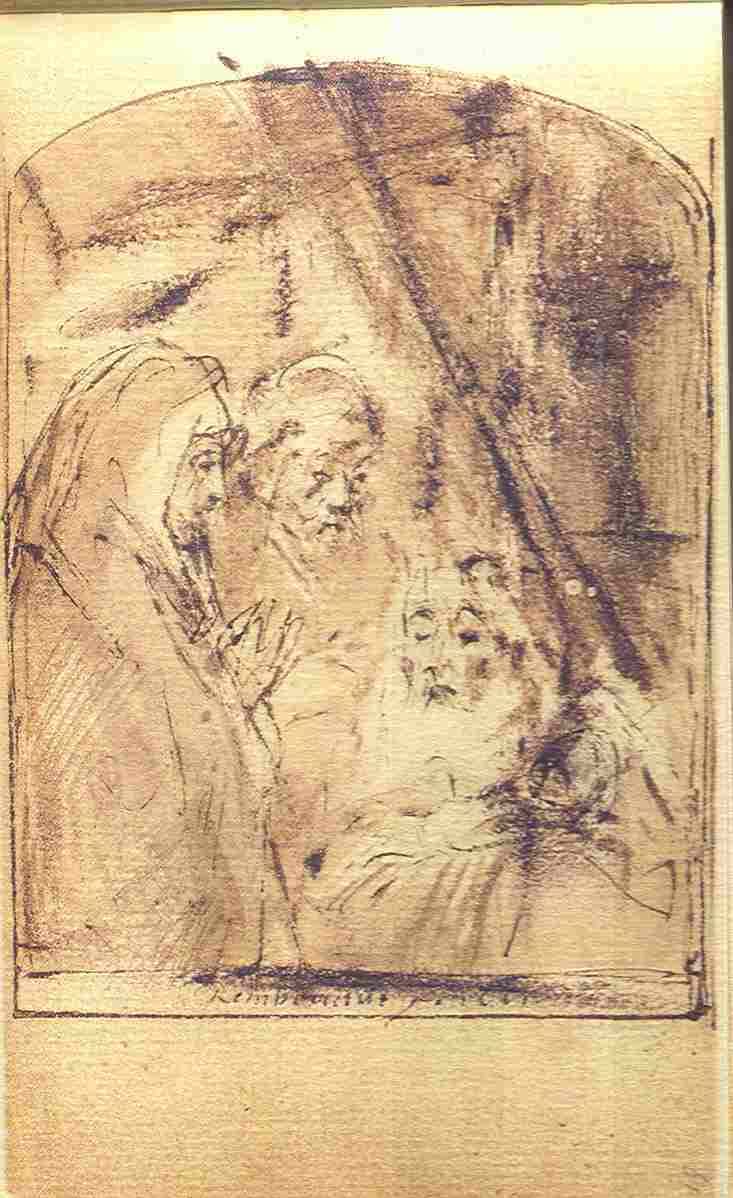
Jacob Heyblocq’s album. Heyblocq, later rector of the Latin school in Amsterdam, began his album in 1645 as a student of theology in Leiden and kept it until 1678. It holds 196 entries, among them 41 drawings. The poets Joost van den Vondel, Jacob Cats, and Constantijn Huygens wrote in it, and in 1661 Rembrandt drew the old Simeon holding the infant Jesus on one of its pages. The book is 92 by 153 millimeters, about the size of a postcard. It is in the Koninklijke Bibliotheek in The Hague.
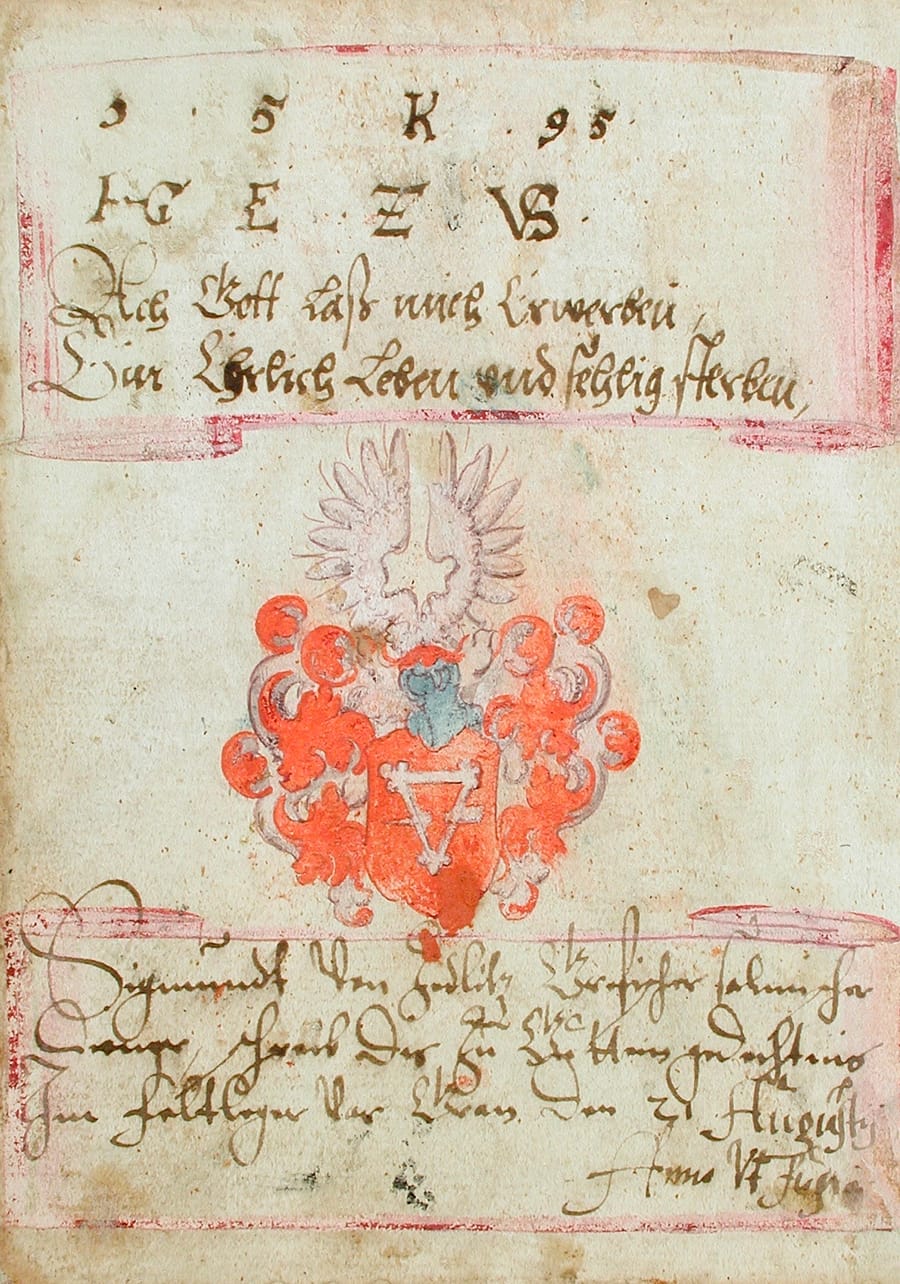
Philipp Hainhofer’s Great Album. Hainhofer (1578–1647) gathered entries from 1596 onward. The emperors Rudolf II and Matthias wrote in his album, as did King Christian IV of Denmark. After Hainhofer died, Duke August the Younger of Brunswick-Lüneburg tried to buy it from his heir and failed. The album passed out of sight until it came up at auction in New York in 2006. In August 2020 the library that bears the duke’s name, the Herzog August Bibliothek in Wolfenbüttel, bought it for about 2.8 million euros.
Ernst Brinck’s album holds an entry by Galileo Galilei.
Beethoven’s album. When Ludwig van Beethoven left Bonn for Vienna in 1792, his friends wrote a Stammbuch for him as a farewell. In it Count Ferdinand Waldstein wrote the line for which the book is remembered: with steady work, Beethoven would receive “Mozart’s spirit from Haydn’s hands”.
The album and the recipe book
The libraries that keep these albums describe mottoes, verses, songs, coats of arms, and drawings in them. They do not describe recipes.
Recipes were kept in another handwritten book of the same centuries, the household recipe book. The Folger Shakespeare Library, which holds the world’s largest collection of such books from early modern Britain, says they were often compiled by women, who collected recipes for the kitchen and for the sickroom from family and neighbors, and that they were passed down and added to from one generation to the next.
So the two stood side by side on the shelf: one book that gathered the words of a person’s friends, and one that gathered the recipes of a family and its neighbors. Each was written by many hands.
How did it become the autograph book?
The fashion rose and fell. In 1642 the English historian Thomas Fuller called the album a “dull Dutch fashion”, and by 1700 few people in the Dutch Republic kept one. In the 1750s it returned.
According to the Dutch national library, the general public took up the friendship album in the 19th century, and keeping one became more and more a pastime for girls. By the end of that century it had become the Poesiealbum, the poetry album that family and friends filled with verses and decorated with stickers.
The custom crossed the Atlantic as well. In the United States, friendship albums rose to popularity in the early 19th century, especially among young women, and were filled with poetry, essays, watercolors, and short stories, as the University of Pennsylvania’s guide to them describes. The autograph book that classmates sign for one another belongs to the same family.
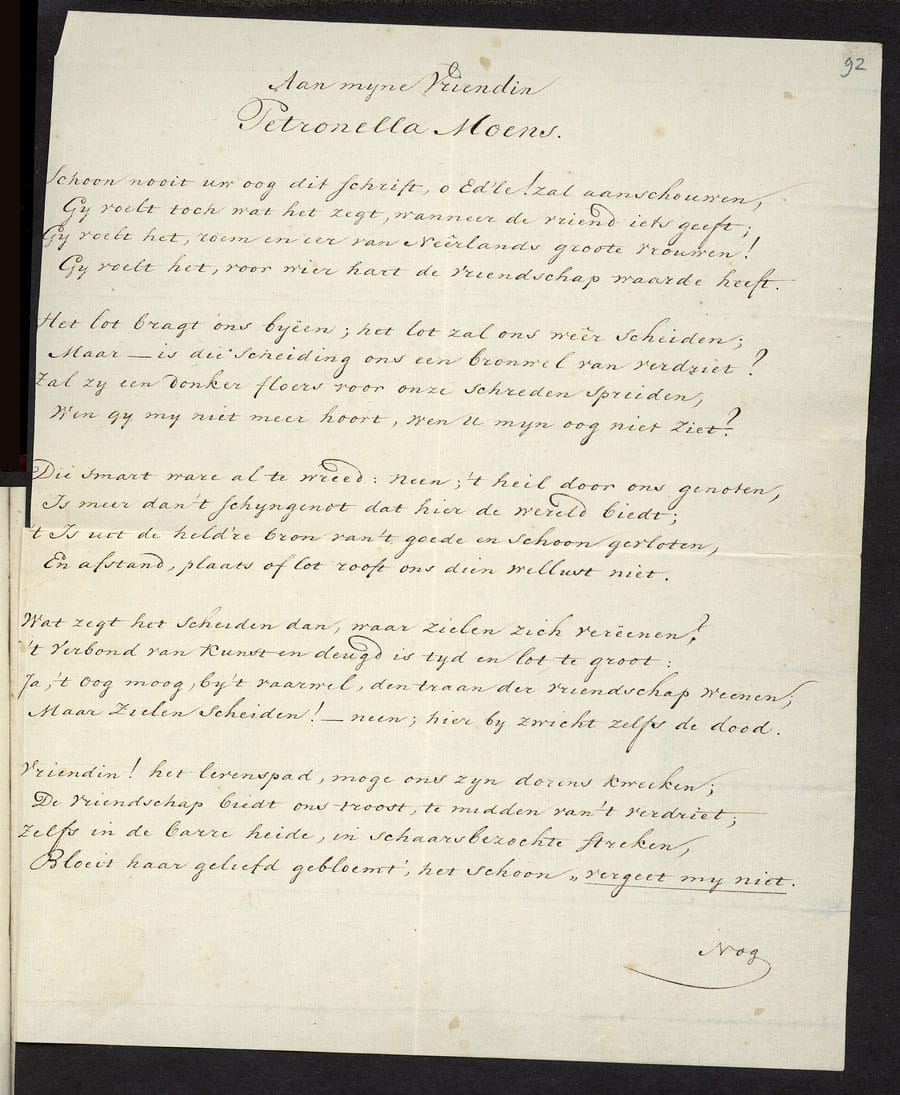
Where are the albums now?
In libraries, and increasingly online. The Herzogin Anna Amalia Bibliothek in Weimar holds about 3,000 albums from 1550 to 1950, which it describes as the largest collection in the world. The Koninklijke Bibliotheek holds some 700, and keeps a register of about 2,000 Dutch albums from before 1800. The Repertorium Alborum Amicorum, begun at the University of Erlangen-Nuremberg, catalogues albums in libraries and private hands across the world.
Many have been photographed page by page and can be read by anyone. The pictures on this page come from two such collections.
The tradition and Amicorum
Amicorum takes its name from this book, and one idea: that the record of an occasion is best written by the people who were part of it.
Amicorum gathers notes, recipes, and photographs from friends and family through a private link, and has them printed and bound as a hardcover book. The steps are set out in The Process.
Sources
- Sophie Reinders and Jeroen Vandommele, “Introduction: A Renaissance for Alba Amicorum Research”, Early Modern Low Countries 6 (2022), pages 1–13. The source for the origins at Wittenberg, the spread of the custom, the catalogue’s counts, the students’ ages, women’s albums, Thomas Fuller’s remark, and Galileo’s entry.
- Koninklijke Bibliotheek, the national library of the Netherlands, “Alba amicorum”, on its collection and on the album in the 18th and 19th centuries.
- Koninklijke Bibliotheek, “Jacob Heyblocq’s friendship book”.
- Stanford Libraries, “German Stammbücher or Libri amicorum from the 16th–20th Centuries”, a guide by Kathleen Smith.
- Herzog August Bibliothek, Wolfenbüttel, “Das Große Stammbuch von Philipp Hainhofer” and its announcement of the purchase, in German.
- Klassik Stiftung Weimar, “Stammbuchportal”, on the collection of the Herzogin Anna Amalia Bibliothek, in German.
- Österreichische Nationalbibliothek, “Beethoven. Menschenwelt und Götterfunken”, in German.
- Folger Shakespeare Library, “Our Recipe Books”.
- University of Pennsylvania, Cultures of the Book, “Collection of American Friendship Album Resources”.
- The pictures: the Koninklijke Bibliotheek’s albums of Seino Mulert, Jacob Heyblocq, and Petronella Moens, and the Los Angeles County Museum of Art’s Album Amicorum of a German Soldier, all in the public domain, by way of Wikimedia Commons.